
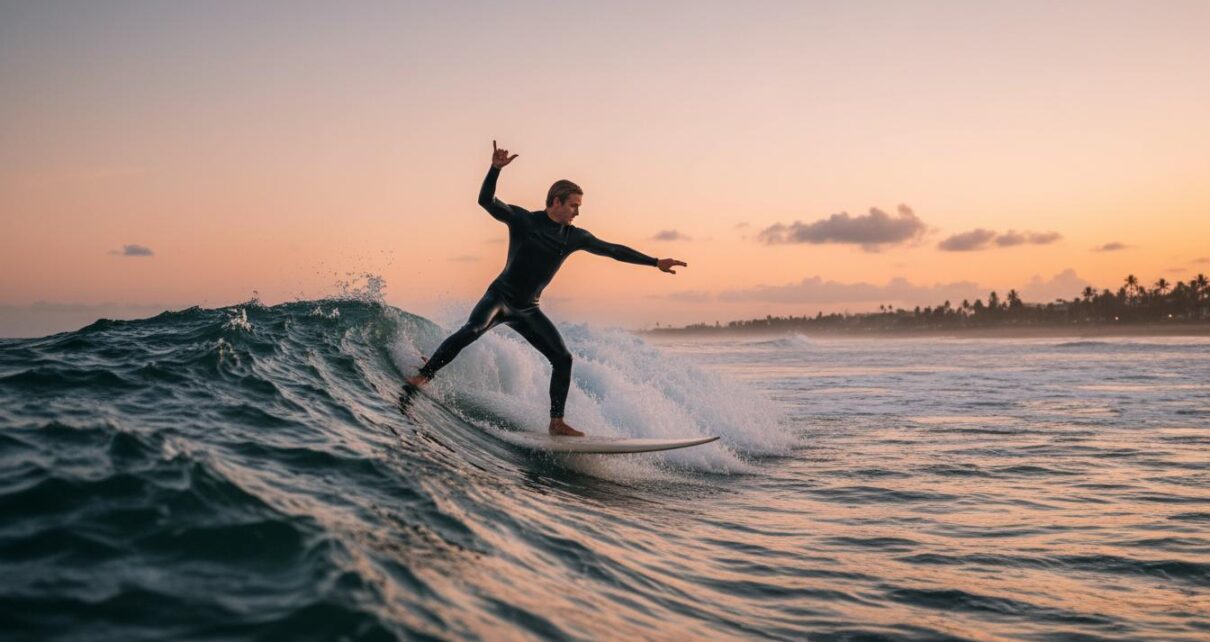
There’s a certain magic when toes curl over the nose of a longboard and the board keeps gliding like it has its own mind. That’s the hang five. It’s stylish, surprisingly technical, and absolutely doable on New Zealand waves if you know how it works. In this guide, you’ll learn what hang five means, the mechanics behind it, the different types and variations, when and where it works best in Aotearoa, how to choose the right gear, and the exact steps to land your first one with confidence.
What is
Hang five is a classic longboard move where the surfer walks to the front of the board and places five toes over the nose while the board trims across the wave. It’s a form of noseriding that shows control, timing, and smooth footwork. Think of it as a balance act between the push of the wave and the hold of your fin and tail.
Hang five differs from hang ten. In hang ten, both feet are on the nose. In hang five, only your front foot hangs over, with your back foot still on the deck behind the nose line. Hang five usually comes earlier in a ride and is more forgiving, making it the best entry point for noseriding.
Outside surfing, hang five also appears in longboard skating and BMX flatland as a front-weighted balance move. On water or land, the idea is the same: controlled forward balance over a stable platform.
How it works
The mechanics in plain words
Hang five relies on keeping the tail anchored while the nose lifts just enough to avoid pearling. Here’s what’s going on under your feet:
- Trim and speed: You need enough speed for the board to plane. Without it, the nose sinks when you step forward.
- Tail hold: A large single fin and a slightly dropped tail create drag that acts like a handbrake, holding the board in the pocket.
- Wave energy: As water runs along the deck and rails, lift forms under the nose. Smooth, peeling waves provide the cleanest lift.
- Weight distribution: Your front foot hangs over the nose; your back foot stays near the front third. Micro-adjustments through your ankles and hips keep the board level.
Ideal waves in Aotearoa
Hang five thrives on small to medium, peeling faces with a gentle pocket. In New Zealand, look for:
- Point breaks with long, even shoulders: Raglan’s inside sections on smaller days, or the points around Taranaki when the swell backs off.
- East Coast rollers: Mount Maunganui, Whangamatā, and Gisborne beaches when winds are light.
- Mellow beachies: Lyall Bay on clean mornings, Sumner on smaller tides, and Orewa when it’s glassy.
West Coast beach breaks like Piha and Muriwai can be steep and punchy. You can still hang five on inside reform sections, but it’s harder and riskier when the lip throws.
Footwork and timing
Most failed hang fives come from rushing the walk. The board must be stable before you move. Cross-step smoothly, keep your shoulders stacked over the stringer, and aim to set your toes just over the nose, not your whole foot. If the board starts to bog, step back immediately and re-trim.
Types / examples
Surf variations you’ll see
- Clean hang five: Five toes over, upright stance, board trimming just below the lip.
- Cheater five: A low crouch with a little back-foot drag or rail pressure to keep speed and hold.
- Backside hang five: Same idea but riding with your back to the wave; needs stronger rail control.
- Switch hang five: Swapping stance before stepping up—advanced and stylish.
- Hang five to hang ten: Step into a hang five, then slide the back foot forward to add the other five toes.
On land: skate and BMX
- Skate longboard hang five: A nose manual with the front foot over or at the tip and the back foot light or lifted, rolling on the front truck.
- BMX flatland hang five: Rider balances on the front wheel while standing on a front peg, other leg extended for counterbalance.
Practising the feeling of forward balance on land can help your ocean timing, but water adds speed, fins, and a moving face—so the transfer is more about awareness than muscle memory.
Quick comparison
| Move | Discipline | What it looks like | Best equipment | Best surface/conditions | Difficulty | Common mistake |
|---|---|---|---|---|---|---|
| Hang Five | Surfing | Five toes over the nose, back foot behind | 9’0”–10’+ log, single fin, wide nose | Waist–chest high peeling waves | Intermediate | Rushing the cross-step; nose pearling |
| Hang Ten | Surfing | Both feet on the nose | Classic log with deep nose concave, big pivot fin | Clean, lined-up points | Advanced | Not enough tail hold; stepping too far |
| Cheater Five | Surfing | Low hang five with back-foot drag/pressure | All-round longboard, 2+1 or single fin | Soft beachies and small points | Lower–Intermediate | Over-braking and stalling out |
| Hang Five Manual | Skate longboarding | Nose manual with front foot at tip | Top-mount dancer or surfskate | Smooth, flat pavement | Intermediate | Leaning too far forward |
| Hang Five | BMX flatland | Front-wheel balance on peg, leg extended | Flatland BMX with front pegs | Flat, grippy concrete | Advanced | Speed too low to stabilize |
Pros and cons
Why learn to hang five
- Style points: It’s timeless and looks great in photos and clips.
- Wave reading: You’ll feel pockets, sections, and trim lines better than ever.
- Board control: Cross-stepping sharpens every part of your longboarding.
- Versatility: Works on points and mellow beach breaks across New Zealand.
What to watch out for
- Wave dependency: Steep, lurchy surf makes hang five difficult.
- Gear sensitive: The wrong board or fin setup can fight you every step.
- Risk of pearling: Mis-timed steps can bury the nose and pitch you forward.
- Line-up etiquette: Walking forward limits manoeuvrability—be mindful of others.
How to use or choose
Step-by-step: Your first hang five
- Pick the right wave: Waist- to chest-high, peeling, with a clean face and no strong cross-wind.
- Set a high line: Angle across the face on takeoff and trim just below the lip for speed.
- Stabilise first: Two or three pumps or a subtle stall to seat the tail in the pocket.
- Cross-step smoothly: One clean cross-step at a time. Keep shoulders over the stringer.
- Feather the brake: A tiny bit of back-foot pressure to keep the tail engaged as you move.
- Place five toes: Let your front foot reach over the nose—just the toes. Keep knees soft.
- Look where you’re going: Eyes down the line, not at your feet. Breathe and relax.
- Micro-adjust: Use ankles and hips to level the board. Arms quiet, not flapping.
- Exit early: If speed fades or the section steepens, step back one count and re-trim.
- Link it up: As you improve, hold the hang five longer, then step to hang ten or into a cutback.
Choosing the right board and fin
- Length and outline: 9’0”–9’6” is a sweet spot for most riders; go longer if you’re heavier or want maximum glide.
- Nose width: A wider, fuller nose gives lift and room for your toes.
- Rocker: Low to moderate nose rocker helps planing; too much rocker kills speed on small waves.
- Rails and bottom: 50/50 rails and subtle nose concave help hold and lift without chatter.
- Fin setup: A single fin in the 8.5”–10” range set slightly back increases tail hold for hang five.
- Wax and deck grip: Fresh wax up front is non-negotiable for confident steps.
Local conditions and timing
- Tides: Many NZ beach breaks clean up on mid to high tide; points can prefer mid dropping. Watch your local spot.
- Wind: Early glass-offs or light offshore winds make noseriding far easier.
- Crowds: Practise on quieter banks or inside runners to avoid cutting across others.
Safety and etiquette
- Know priority: Don’t step forward if another surfer is paddling out in your line.
- Rips and reefs: West Coast rips can move fast; keep an exit plan.
- Leash checks: A longboard leash can tangle when you walk—keep it straight and clear.
FAQ
What does hang five mean?
Hang five is a longboarding move where you ride with five toes over the nose of the surfboard while trimming along the wave.
Is hang five hard to learn?
It’s achievable for intermediate surfers who can trim, bottom turn softly, and cross-step. The right wave and board make the biggest difference.
What size board is best for hang five?
Most surfers progress fastest on 9’0”–10’+ logs with a wide nose and a single fin around 8.5”–10”.
Can I hang five on a shortboard?
Not realistically. Shortboards lack the nose area, fin hold, and stability needed for noseriding.
Which New Zealand spots suit hang five?
Look for clean peelers: Raglan’s mellower sections, Mount Maunganui on small days, Whangamatā, Gisborne beaches, Lyall Bay mornings, and Sumner when it’s tidy.
How do I stop the nose from pearling?
Build speed before stepping, keep the tail engaged with a bigger fin, and step back early if the section steepens.
Single fin or 2+1 for hang five?
A single fin set slightly back offers the most tail hold for classic noseriding. A 2+1 can work but often feels looser up front.
Backside or frontside—what’s easier?
Frontside is easier for most surfers because you can see the lip and pocket. Backside hang five needs stronger rail pressure.
How long does it take to learn hang five?
With suitable waves and gear, consistent practice over a few weeks can get you there. Timing and footwork improve with every session.
Can I practise hang five on land?
Yes. Longboard skating and even BMX flatland hang five build forward-balance awareness. It won’t replace ocean time but helps coordination.
What’s the difference between hang five and hang ten?
Hang five is one foot’s toes over the nose; hang ten is both feet on the nose. Hang ten needs more speed, hold, and precision.
Any quick drills to speed up progress?
On small days, practise two-step cross-steps without noseriding, then add a brief hang five for one second, step back, repeat. Keep reps high and movements smooth.
Final thoughts
Hang five rewards patience and tidy footwork. Choose forgiving New Zealand peelers, set up the right log and fin, and build a smooth, unhurried walk. When those five toes slip over the front and the board keeps humming, you’ll feel exactly why this classic still turns heads.